the enemy of good
writing advice from the afterlife

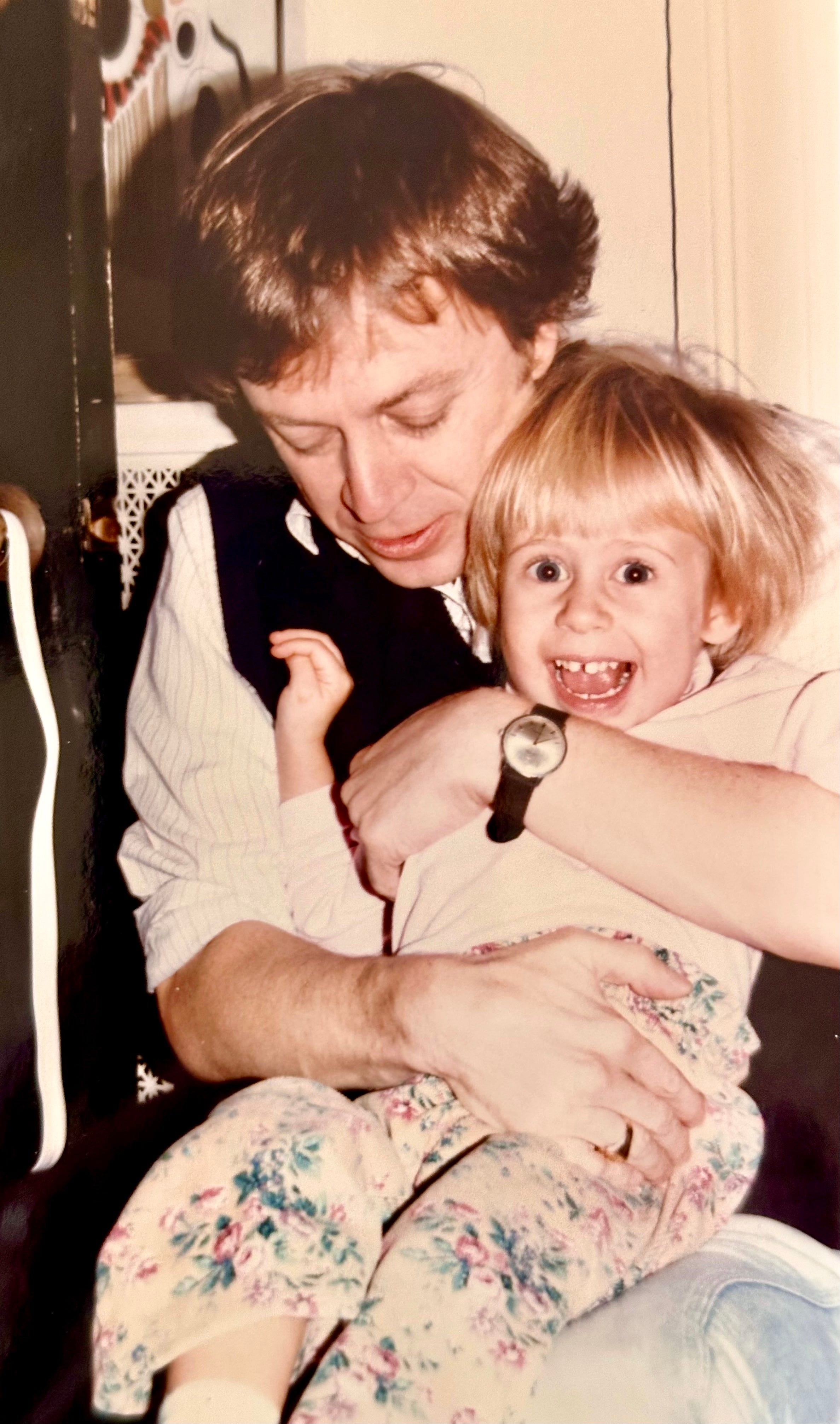
My dad died last month. He was a retired journalist and editor. I co-wrote his death notice with his longtime friend, Brenda, who gathered his work history while I figured out the family stuff. We exchanged many emails, and it felt good to have a project. At one point, she acknowledged we could do this forever and said it was time “to let go with good.” One of my dad’s old expressions, she said, was “Better is the enemy of good.”
Shortly after, my mom shared a letter from another former colleague, who recalled being upset over a “lousy” piece she’d brought to an edit. My dad read it and asked if she knew the expression, “Perfect is the enemy of good.” She asked what he meant, and he said, “If you try to make it perfect, you’ll never get anything done. Go for the good.”
In the wake of my dad’s death, I’ve experienced a couple inexplicable “coincidences,” which reinforce my belief (already established) that death is not the ending our materialist culture dismisses it as. This did not feel like one of them. It struck me as a bit cliche. I could vaguely remember my dad saying something like this to me, yet wanted to hold myself to higher standards. Also, he worked in news radio, where there were real time constraints, while I was usually writing fiction, which I could fiddle with forever with minimal consequences. There’s no dead air if you don’t finish a short story.
Also, a discrepancy: Brenda said “better” was the enemy of good, while the other friend said “perfect.” Someone must have been misremembering.
Then I signed up for a paid subscription to Elif Batuman’s newsletter. I’m a fan of her work, plus her latest post was called “On Lost Time,” and I’m also a fan of Proust. In it, Batuman recalls a “French ex” who used to tell her, “Le mieux est l’ennemi du bien.” She linked to the phrase’s Wikipedia, where I learned it comes from Voltaire, quoting an Italian proverb in a poem:
Dans ses écrits, un sage Italien
Dit que le mieux est l’ennemi du bien.
(In his writings, a wise Italian/ says that the best is the enemy of the good.)
Here was the third coincidence in a series I could no longer ignore and an explanation for the word discrepancy. Le mieux is directly translated as “the best.” It’s related to the French word for better, meilleur, which derives from the Latin word for better, meliorem (like "ameliorate”). Le mieux could be translated here as “the best,” “perfect,” or “better.” My dad knew French and likely used these translations liberally. Neither of his friends were necessarily misremembering.
My preferred translation is, “Better is the enemy of good.” “Perfect” is an almost meaningless word to me at this point, as I know it’s unattainable, yet that doesn’t stop me from feeling dissatisfied. “The best is the enemy of the good” seems too adversarial: X is the best writer. Y is a good writer. X is the enemy of Y. I’ve definitely framed things like this for myself before, but it’s not true, helpful, or the way my dad meant it.
I also like how “Better is the enemy of good” speaks to the optimization mindset of our tech overlords, whose many “improvements” have made life less rich and meaningful. Putting aside work or writing, most of us are still striving to be better in some way. But what if we’re already good? And what if good is good enough?
Until recent years, when dementia took hold, my dad regularly edited my work. He was often my first--and sometimes only--reader. I took his edits seriously, even if I didn’t listen when he told me better is the enemy of good. So he took things in his own hands and showed me.
At the start of 2009, I was home for the holidays, applying to MFA programs, and in a precarious mental state. I was usually either drinking or hungover, full of hubris or self-loathing. I was applying to at least a dozen different programs to increase my odds of getting into one with funding (don’t go into debt for an MFA). UVa, where Ann Beattie and Deborah Eisenberg taught, had a postmark deadline for January 2nd.
I stayed up the whole night before this date, reworking my writing sample until I was thoroughly disgusted with it. UVa had an acceptance rate of something like 1%, and I knew it was never going to happen. “Fuck it,” I said, “I’m going to bed.”
My dad had just woken up for the day. He forced me to print out my writing sample despite my assurances it was useless. Then I went to bed, and he took my application to the post office and mailed it himself.
A few months later, I was accepted to UVa. It was my only real acceptance, although I later got into another program off the waitlist. But UVa wanted me; Ann Beattie wanted me (I learned later she read my application), a fact that continues to buoy me, even though I don’t feel I lived up to her expectations (she definitely didn’t tell us better is the enemy of good).
My precarious mental state continued while I was at UVa, although my time there changed my life. I read and wrote many things I wouldn’t have otherwise. The degree came with teaching experience and qualification, which is how I supported myself for nearly a decade. And I met Joe, whom I married and had kids with.
None of this would have happened if not for my dad. He lived by his words. He wouldn’t let me sabotage myself to the demon of perfectionism.
Yet even now, long after, I still regularly sabotage myself to the enemy of good, especially with my own writing, although I rarely view it that way. I view it as disillusionment, dissatisfaction, procrastination. It’s all the same, though, an unwillingness to “let go with good.”
So okay, Dad, I hear you. I’ll go for good.
It also feels necessary to point out that this aphorism, while useful in many ways, is not applicable to situations of moral injustice. It’s like when I told Joe about the “let them theory,” which has applications in my personal life, and he said, “It doesn’t work for genocide.”
My dad had a very strong moral code, and I’m glad dementia buffered his awareness of our country and world in recent years. I don’t think he would have been surprised by it, though. I can’t remember the first time he talked to me about Palestine, but it was long before people discussed it as freely as they do now (although attempts to stifle the discussion continue now; they’re just failing. As Rayya Elias said: “The truth has legs. It always stands.”)
At his job, my dad covered the Middle East for many years, so I believed him when he told me about the forced expulsion of Palestinians and the way groups like AIPAC worked to stop him and other journalists from reporting truthfully on it. In retrospect, it’s remarkable he spoke so openly to me about this, as he took journalistic objectivity so seriously he wouldn’t even tell me which presidential candidate he was voting for (as if it weren’t obvious).
Yet he knew what was happening to Palestine1, and our country’s role in it, was wrong. And he told me this at a time when no one else did. I’m also incredibly grateful for that.
In my dad’s death notice, we asked people to contribute to public radio due to the federal cuts and because he helped so many people in public radio. This was my mom’s idea, and it felt right.
Yet if it were up to just me, I would have requested donations to mutual aid groups in Palestine in my dad’s honor. So I’m doing that here. If my dad or his story had an impact on you, please consider donating to Operation Olive Branch, the Sameer Project, or the Zaynab Project. And continue to speak about Palestine, like my dad did, and against the U.S.-backed genocide of the Palestinian people.
For more on this history, I recommend The Hundred Years’ War on Palestine by Rashid Khalidi and/or A Very Short History of the Israel-Palestine Conflict by Ilan Pappe.
What a wonderful piece, thank you so much for sharing.
This is so beautiful, Caitlin. I keep coming back to it. I was really sorry to hear about your dad's passing, but glad to learn a bit about him. May he rest in peace and may your memories of him buoy your spirit forevermore.